
Ghost in the Shell and Jaadugar A Witch in Mongolia Crossover Science SARU Collab Explored
Anime crossovers can be painfully predictable. Throw two popular characters into the same poster, slap a few logos on it, and call it a celebration. But Science SARU somehow made its latest collaboration feel genuinely fun. The studio has released a new crossover illustration connecting THE GHOST IN THE SHELL and Jaadugar: A Witch in Mongolia, two of the most interesting anime airing during Summer 2026, and honestly, I didn’t expect to like this pairing as much as I do.
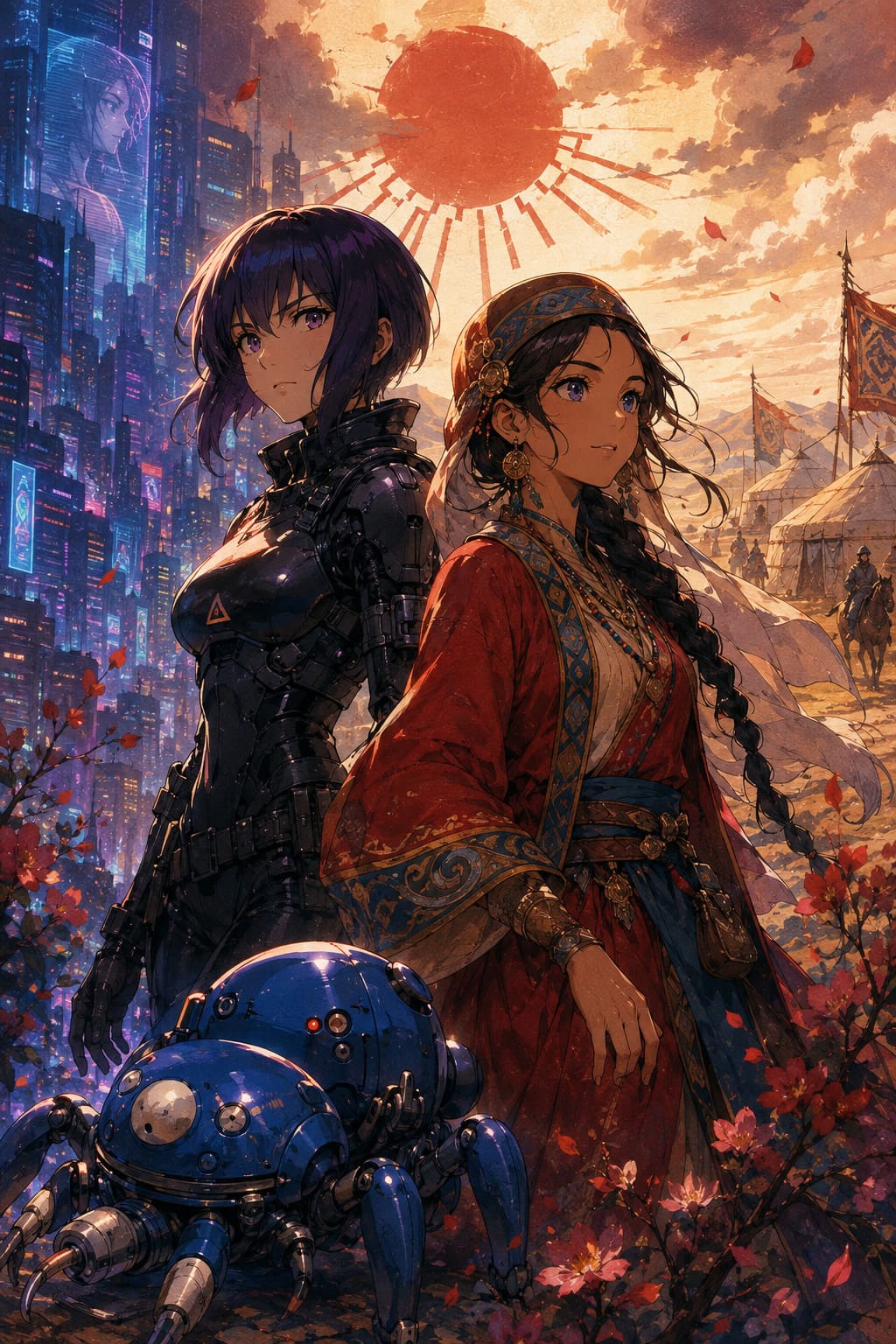
The artwork was created by Abel Gongora, director of Jaadugar, and puts Major Motoko Kusanagi in the same frame as Sitara. A futuristic cybernetic investigator standing beside a heroine from the 13th-century Mongolian and Persian world sounds completely ridiculous on paper. Somehow, though, it works. There is a strange charm to seeing these two women from wildly different worlds brought together, especially because both characters are far more alike than their settings initially suggest.
Science SARU’s Crossover Is Much Better Than It Has Any Right to Be
What immediately grabbed me about the illustration is how little it resembles a conventional Ghost in the Shell promotional image. Motoko is usually associated with sleek cyberpunk architecture, cold lighting, machinery and that unmistakable futuristic atmosphere. Here, Science SARU allows her to exist inside Gongora’s much softer and more expressive visual language, with a Tachikoma nearby and Sitara standing comfortably in the same scene.
That contrast is exactly what makes the image memorable. It doesn’t try to pretend that THE GHOST IN THE SHELL and Jaadugar belong to the same genre. Instead, it celebrates how different they are. One story is obsessed with technology, artificial consciousness and the meaning of being human, while the other is rooted in history, political survival, medicine and the brutal realities of empire.
And yet both protagonists have something important in common: they are intelligent women trying to survive systems much larger than themselves. Motoko deals with governments, corporations and cybernetic networks. Sitara has to navigate a gigantic political machine built around conquest and power. Different centuries, different weapons, completely different rules — but the pressure placed on both characters feels surprisingly familiar.
Why the Illustration Feels So Different
Gongora’s drawing doesn’t seem interested in making Motoko look intimidating for the sake of it. Instead, the characters have a warmth and looseness that you wouldn’t necessarily expect from a Ghost in the Shell crossover. The Tachikoma also helps enormously because its playful design gives the entire image a lighter personality without turning the characters into comedy versions of themselves.
That is where Science SARU’s identity really comes through. The studio has never been particularly interested in making every production look identical, and its recent work on shows such as Dandadan and Scott Pilgrim Takes Off proves how comfortable it is with unusual visual choices. This collaboration feels like another small reminder that Science SARU is at its best when it is allowed to experiment.
THE GHOST IN THE SHELL 2026 Is Taking a Different Route
The new THE GHOST IN THE SHELL anime has had a pretty fascinating reception since its July 2026 premiere. If you grew up with Mamoru Oshii’s 1995 movie or spent years watching Stand Alone Complex, this version can feel strange at first. It isn’t trying to simply recreate the visual language fans already associate with the franchise, and I think that is ultimately a good thing.
Directed by Mokochan, who previously worked as an assistant director on Dandadan, the series moves closer to the spirit of Masamune Shirow’s original manga while giving the material a distinctly modern presentation. To Enjo handles the series composition and scripts, while Shuhei Handa provides the character designs. The result is a version of Ghost in the Shell that feels more fluid and expressive than some longtime fans may have expected.
The core questions haven’t disappeared, either. Artificial intelligence, cybernetic bodies, identity and the mysterious idea of the human “ghost” inside a synthetic shell remain central to the story. What has changed is the way those ideas are presented. Personally, I enjoy that the series isn’t desperately trying to imitate the atmosphere of the 1995 film. That movie already exists, and trying to copy it would have been the safest and least interesting option.
- Director: Mokochan
- Series Composition: To Enjo
- Character Design: Shuhei Handa
- Music: Taisei Iwasaki, Ryo Konishi and Yuki Kanesaka
- Streaming: Prime Video
The music deserves a mention too. Taisei Iwasaki, Ryo Konishi and Yuki Kanesaka give the show an identity of its own, and that matters because music is one of the easiest ways for a new Ghost in the Shell adaptation to accidentally feel like a pale imitation. So far, the soundtrack has helped this version establish its own mood rather than constantly reminding viewers of what came before.
Jaadugar: A Witch in Mongolia Is the Show I Didn’t Expect to Get This Invested In
Then there is Jaadugar: A Witch in Mongolia, which might be the more surprising half of this collaboration. Based on Tomato Soup’s josei manga Tenmaku no Jaadugar, the series follows Sitara, a Persian girl whose life is destroyed by the expansion of the Mongol Empire. Her eventual position alongside Toregene gives the story a completely different kind of tension from traditional historical anime.
There are no convenient magical shortcuts here. Sitara survives through intelligence, education, medicine and political awareness. That makes her journey particularly compelling because she isn’t simply fighting an obvious villain. She is trapped inside a huge political structure where one wrong decision can have consequences far beyond her own life.
The series is also refreshingly serious about its setting. Instead of turning the Islamic and Mongolian worlds into a collection of exotic scenery or fantasy stereotypes, Jaadugar spends time building its characters and political environment. That attention to detail is one of the biggest reasons the show has generated so much discussion among anime fans this season.
The Creative Team Behind Jaadugar
There is some serious talent behind the production. Naoko Yamada serves as executive director, with Abel Gongora directing, while Kanichi Kato handles series composition and Kenichi Yoshida works on character designs. Koshiro Hino’s music adds another unusual layer to the production, giving the historical drama an atmosphere that feels distinctly different from the average seasonal anime.
| Anime | Genre | Central Character | Streaming |
|---|---|---|---|
| THE GHOST IN THE SHELL | Cyberpunk / Sci-Fi | Motoko Kusanagi | Prime Video |
| Jaadugar: A Witch in Mongolia | Historical Drama | Sitara | Crunchyroll |
Why These Two Anime Actually Make Sense Together
At first glance, Ghost in the Shell and Jaadugar couldn’t be further apart. One gives us cybernetic bodies and futuristic technology, while the other deals with medieval politics and human survival. But both stories are fundamentally interested in people trying to maintain their identities while powerful institutions attempt to define their lives for them.
That’s why I think the crossover works better than a random promotional stunt. Motoko and Sitara are both characters who rely on their minds. Neither one survives simply because she is physically stronger than everyone around her. They observe, calculate, adapt and look for weaknesses in systems that initially appear impossible to challenge.
There is also something wonderfully funny about the practical implications of the crossover. Give Sitara a Tachikoma and half of her problems suddenly look considerably easier. I’m not saying she needs a futuristic robot army, but after everything this woman goes through, I’d happily let her borrow one.

Science SARU Is Having One Hell of a Summer
The bigger story here is probably Science SARU itself. Having two ambitious anime airing at the same time is impressive enough, but the fact that these productions feel so different makes the studio’s summer lineup even more interesting. It isn’t just serving one type of anime fan.
THE GHOST IN THE SHELL appeals to viewers who want philosophical science fiction, cyberpunk action and questions about artificial intelligence. Jaadugar reaches people looking for character-driven historical drama and political intrigue. The crossover artwork essentially tells both audiences, “You’re watching different shows, but they’re coming from the same creative house.”
And that is probably the smartest thing about the whole campaign. Instead of forcing the two series into some bizarre shared universe, Science SARU simply lets their personalities collide for one image. It is playful, visually unexpected and just self-aware enough to make fans stop scrolling.
My Take on the Ghost in the Shell x Jaadugar Collaboration
I love when anime studios do something like this without overthinking it. Not every crossover needs a complicated story, special episode or manufactured event. Sometimes a great illustration featuring two characters who should never logically meet is enough, especially when the artist understands why putting them together is interesting.
This Science SARU collaboration also made me more curious about the relationship between the two shows. If you’re watching Ghost in the Shell but haven’t given Jaadugar a chance, this is a pretty good excuse to check it out. And if you’re already invested in Sitara’s story, seeing Motoko suddenly appear beside her is the kind of weird little anime moment that makes a seasonal lineup more memorable.
For me, the best part isn’t even the novelty of seeing Motoko and Sitara together. It’s the realization that they actually belong in the same conversation. One fights against systems built from data and machines; the other fights against an empire built from armies and political power. Both are outsiders trying to carve out a little control in worlds determined to take it away from them.
That’s a much better reason for a crossover than simply putting two popular characters on the same poster. And honestly, if Science SARU keeps producing surprises like this during Summer 2026, I’m completely on board.


